No matter which test you're taking - the SAT, ACT, CLT, GRE (or even SSAT or ISEE) - if you're aiming for a near-perfect score, you need an exceptional vocabulary.
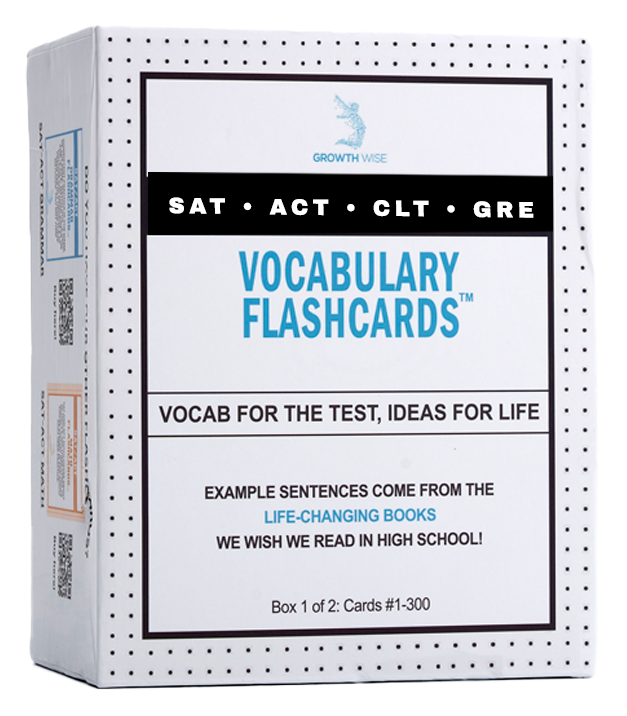
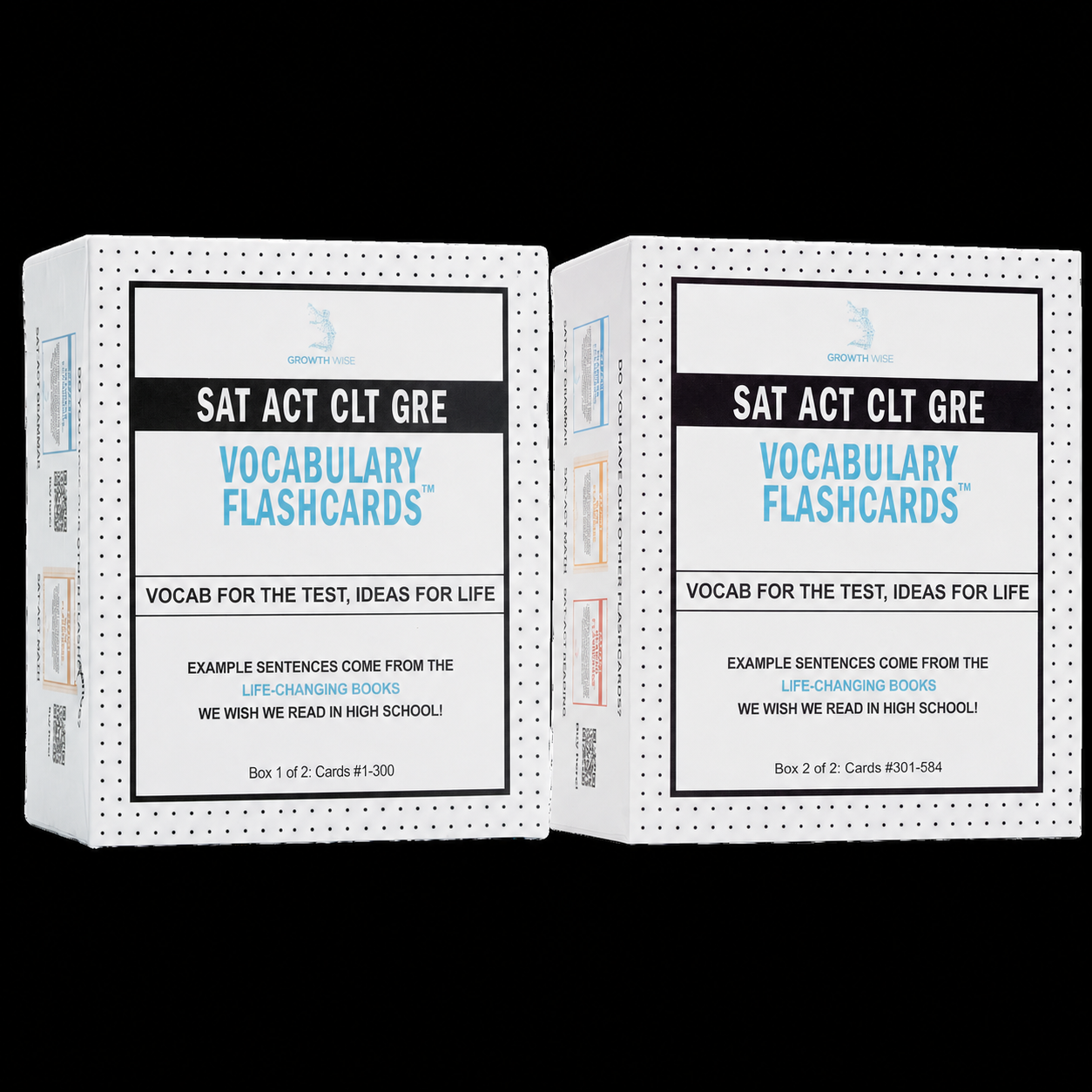
584 flashcards. Every high-frequency vocabulary word that major tests use. The words your teen will still use at 40.
My name is James Treadway (Harvard '08, Peking University '10, London School of Economics '11), and I founded the tutoring company Growth Wise.
After spending 5,000+ hours tutoring teens for the SAT, ACT, ISEE, and SSAT, I've seen that the most literate students score highest in reading comprehension, and they speak the most intelligently, too. Vocabulary is the unsung key.
On the SAT, a top student still misses 3-4 reading questions per test if they lack a college-level vocabulary.
This is true for every major standardized test. Even tests like the ACT that don't "explicitly" have vocabulary questions still use sophisticated words in their reading passages and expect readers to know them.
We didn't just want to give you high-level words that commonly show up on tests, though. We wanted to make them memorable. We wanted every flashcard to be impactful. And our way of doing that was to have every card's example sentence teach a key point from the most life-changing books we've read: books like Frankl's "Man's Search for Meaning" and Cal Newport's fantastic "how-to's" for high school, college, and early career life.
Words that stick require connection. A definition embedded in a meaningful sentence, one that teaches something real, sticks.
"I take the flashcards on road trips with my kids. Whoever gets ten words right gets to choose where we eat lunch! The best part are the example sentences on each card. I love hearing my son think deeply about the books the cards mentioned."
The "Flashcard Summer" That Altered My Life's Trajectory
My summer before junior year of high school, I memorized 700 vocabulary flashcards to prepare for my SAT. I still use those words today, 25 years later. They helped me score a 1520 on my SAT and a 1550 on my GRE five years later, gaining me acceptance to Harvard for college and the London School of Economics for my master's degree. Elite-level vocabulary, literacy, and speech have changed the course of my life.
I wanted these flashcards to do what mine did for me 25 years ago, but at the same time, to do way more. I spent my teens and twenties painfully struggling with social anxiety, poor study habits, and a lack of clarity about what to do with my life. The answers, it turned out, were in the books that I would not discover until years later.
I want teens and aspiring grad students to start figuring those questions out so much younger than I did. So when I built the Growth Wise Vocabulary Flashcards, I made one decision that changes the entire experience:
Your teen learns 584 high-frequency SAT vocabulary words. At the same time, they encounter the core ideas from Cal Newport, Dale Carnegie, Alex Hormozi, James Clear, and others: the reading that took me from a frustrated, unclear teen and 20-something to the successful, fulfilled entrepreneur and educator whom I am today.
This is the only test prep product that treats each student like a whole person worth educating, a bundle of talent and opportunity simply in search of their best path in life, not just someone chasing a test score.
What a Card Actually Looks Like
This is not a flashcard with a word on one side and a dictionary definition on the other. Every card is built to make the word impossible to forget.
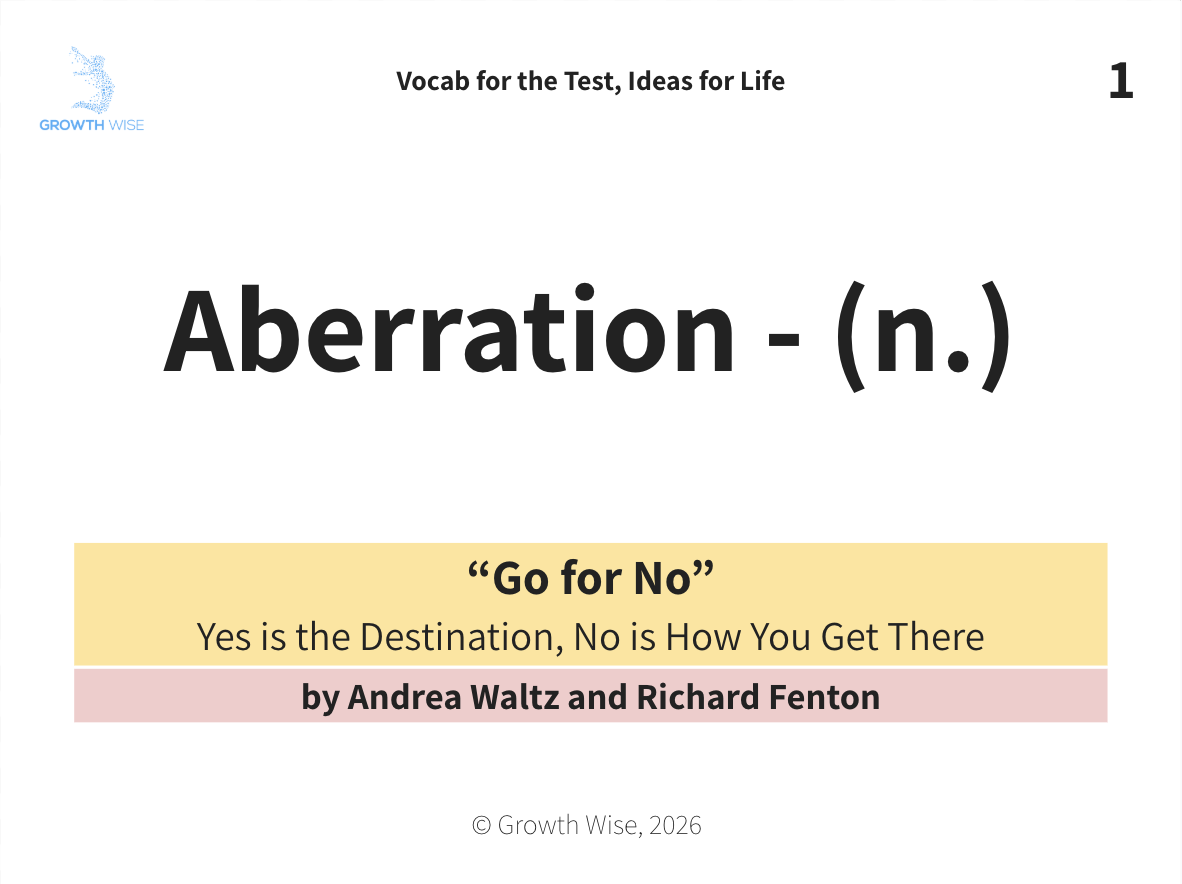
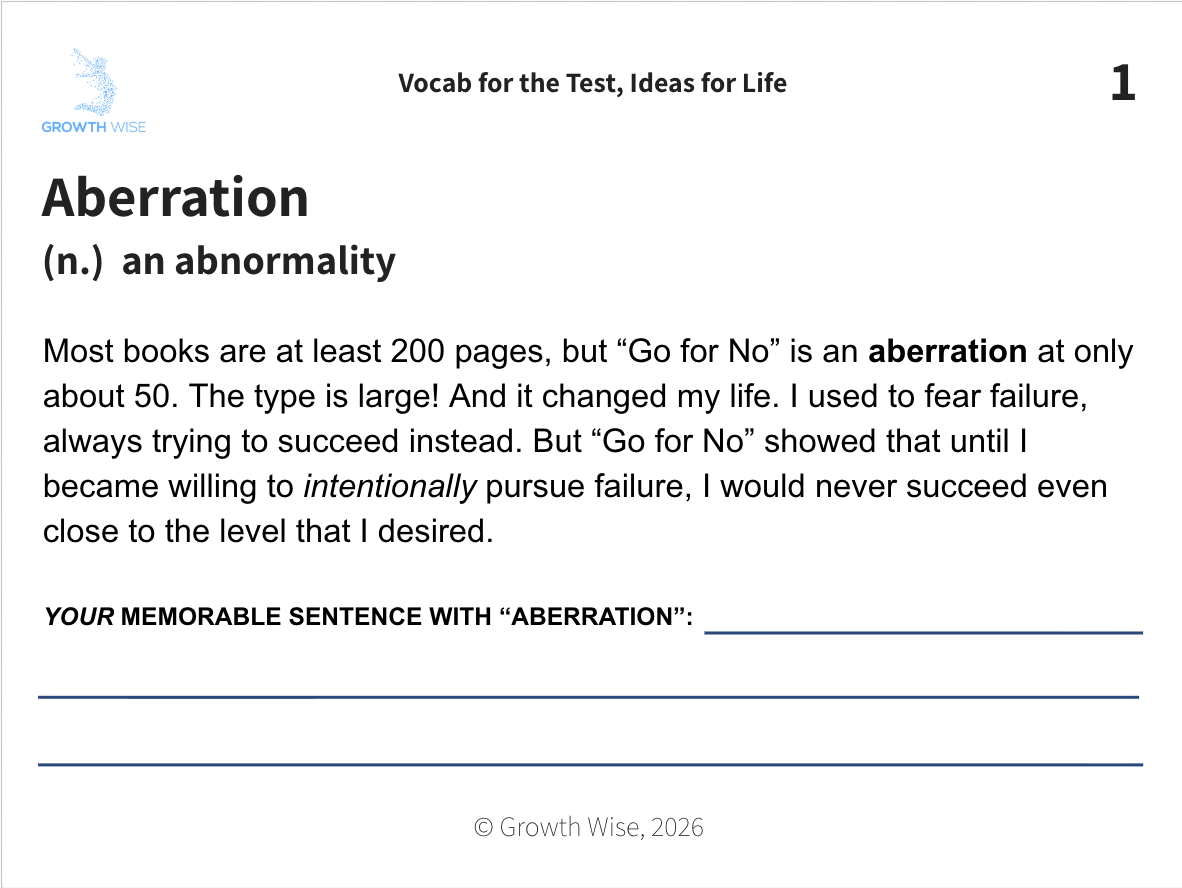
After 584 cards, your teen has not just memorized a list. They have absorbed the concentrated insight of some of the most valuable books written in the last 50 years. And the words stay because they are connected to something that matters.
Famous Authors You'll Learn From While Studying Our Flashcards
Every card's example sentence teaches a key point from world-famous books by the following authors. Learn each vocabulary word in the context of life-changing ideas about career advancement, communication, achieving your dreams, and countless other topics.
Most people never deliberately build their vocabulary. The student who memorizes these 584 words does not just score higher on the SAT, ACT, CLT or GRE. They carry this vocabulary into college, professional settings, anything they read, and every conversation for the rest of their life.
Here is Everything You Get
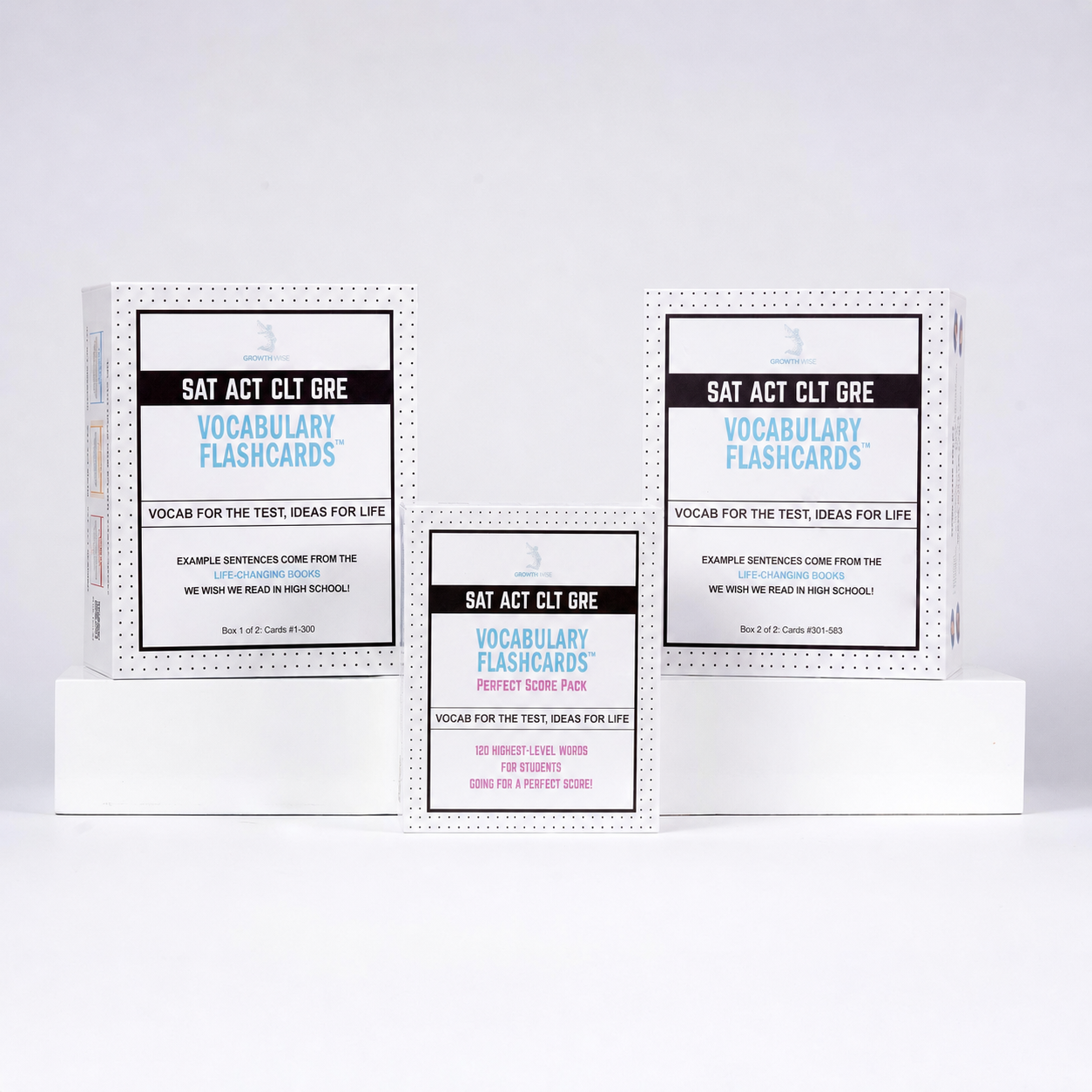
- 300, 584, or 704 college-level vocabulary flashcards Numbered and color-coded: Box 1 - words #1-300, Box 2: words #301-584, Box 3: Our "Perfect Score Pack" with 120 highest-level words.
- Every example sentence teaches a real concept from one of the 30+ most life-changing books that we've read. The word and the idea reinforce each other so that both stick in the mind.
- Vocabulary that lasts beyond the test. These words become part of your teen's natural speech, reading, writing, and thinking. College professors notice. Job interviewers are impressed. Everyone assumes instinctively, "this is a highly intelligent person."
- Money-back guarantee: Memorize the cards. If the your reading score does not rise, you get a full refund. No questions asked.
Why Physical Cards, Not an App
Your teen already uses enough screens. The last thing vocabulary memorization needs is to compete with the same device that hosts Instagram, TikTok, and iMessage. That is not study. That is context-switching.
Physical flashcards enforce single-task focus. No notifications. No temptation to "check something real quick." Just a word, a definition, an example sentence, and the repeated retrieval that burns it into memory.
I memorized 700 words from physical cards the summer before my SAT. Twenty-five years later, those words are still part of my active vocabulary. Every day. In every conversation.
Apps do not produce that outcome. Memorization does.
Meet James Treadway, Founder of Growth Wise

Harvard '08. Peking University '10. London School of Economics '11. 5,000+ hours of SAT/ACT tutoring.
I started Growth Wise because I kept seeing the same pattern. Smart kids. Good parents. Generic prep materials. And vocabulary scores that did not move. Not because the kids were not trying. Because the materials were not built for how words actually stick.
The vocabulary flashcards are the product I am most personal about. They are the direct descendant of the cards I used at 16, upgraded with everything I know now about what actually stays with students. The words. The ideas. Both at once.

Your Money-Back Score-Raise Guarantee
Purchase Box 1 or both boxes. Study the cards for 60 minutes per day for 14 days, actively memorizing the words using the retrieval method we teach you on the free Zoom call.
If your teen's SAT Verbal score does not rise after completing the set, we give your money back. No questions asked.
We built these cards because we believe vocabulary memorization works when the words connect to something real. If it does not work for your teen, you pay nothing.
Also includes a 14-day "just changed my mind" return. No restocking fee, no hassle. You only pay if it works.
Which Pack Would You Prefer?
Every option includes free shipping and the money-back guarantee. Start with Box 1 if the test is coming soon. Get both boxes for complete coverage. Going for a perfect score? Add the Deluxe Pack.
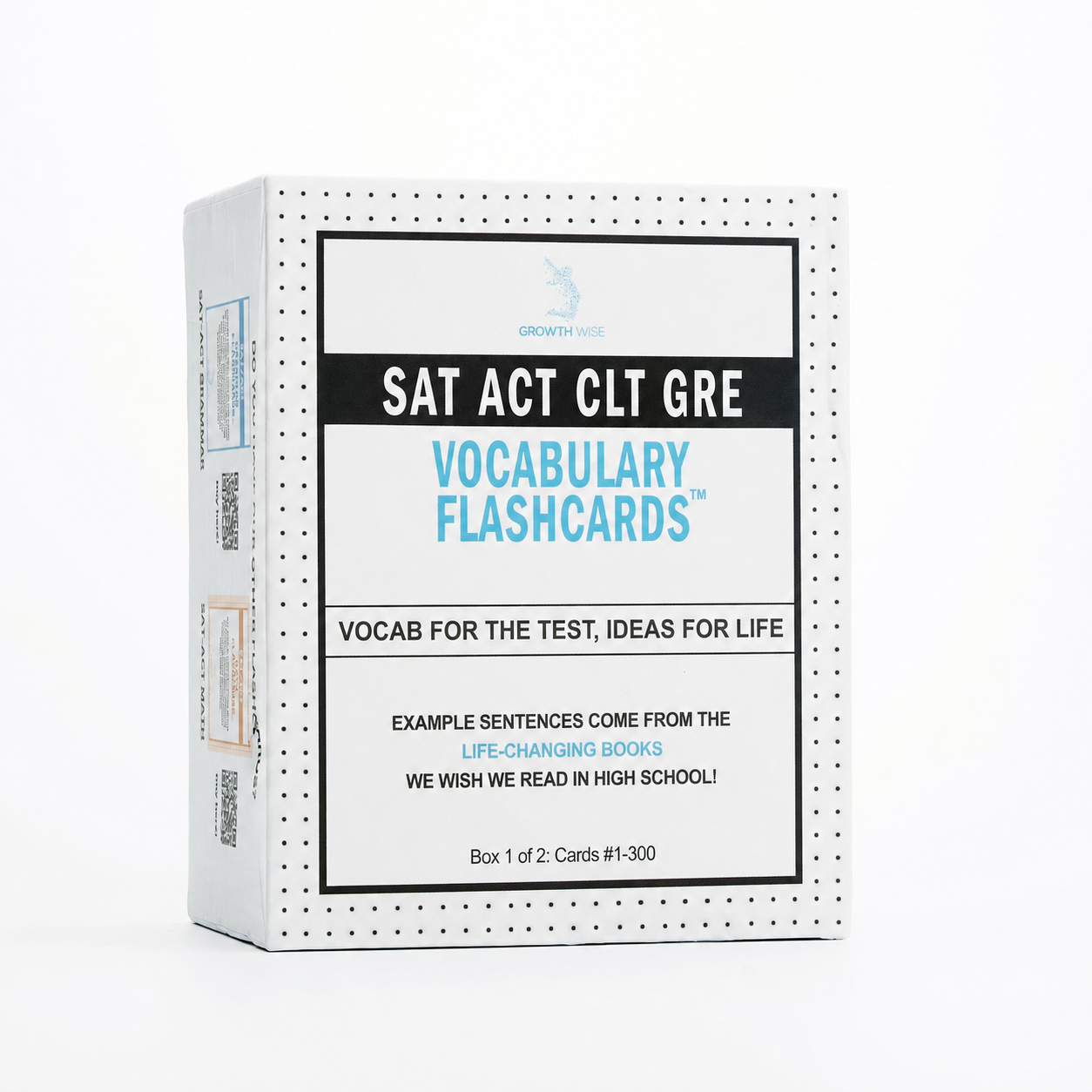
The 300 highest-frequency words
Complete vocabulary curriculum
704 cards in all

Money-Back Score-Raise Guarantee
Memorize the cards. If the score does not rise, you get every dollar back. No questions asked.
Frequently Asked Questions
What makes these different from a standard vocabulary list?
First, the words are selected based on high-frequency appearance on actual SAT, ACT, CLT, and GRE tests, not generic academic word lists. Second, every example sentence teaches a concept from one of the books above, giving the word a memorable context instead of a generic dictionary sentence. That context is why the words stick. A word connected to an idea is fundamentally harder to forget than a word connected to nothing.
My teen is not a reader. Will the example sentences land?
The example sentences are short, one to two lines. They do not require your teen to read the books. They just provide context for each word. Most students find the ideas more interesting than they expected, and some end up wanting to read the full books after the SAT. That is one of the outcomes I am most proud of.
Should we get Box 1, Boxes 1 and 2, or all three with the Perfect Score Pack, too?
Boxes 1 and 2 contain 584 words that will contain many words a student already knows, and many that they don't. The Perfect Score Pack will be mostly words they don't yet know. Gauge your ambition and how much time you have to study them - I memorized 700 words myself my sophomore summer of high school, and they changed my life. If you're looking for a result like that, go for all three boxes.
What if my teen already has a good vocabulary?
Strong general vocabulary still contains gaps for SAT-specific words. The cards target words that appear on actual tests, which are often outside the range of everyday conversation. Even students with strong vocabulary regularly discover gaps. And the example sentences give every student something new, because the book concepts are genuinely valuable regardless of their starting vocabulary level.
Two Paths for Vocabulary Prep.
Your teen can try to memorize words from a generic list, cramming definitions with no context, and forgetting most of it before test day - hoping something sticks.
Or they can spend 30 to 40 minutes a day with 584-700 carefully selected, memorable cards that teach the words and install life-changing ideas from the world's greatest thought leaders alongside them.
Imagine this. Your teen is sitting at the kitchen table six weeks from now. She picks up a word she could not define a month ago and says, "Oh, like what Cal Newport calls deep work." She does not just know the word. She understands the concept behind it. And when that word appears on the SAT, she does not hesitate. She knows it.
- 584 SAT vocabulary flashcards. Physical cards, not an app.
- Every example sentence teaches a concept from a world-class book.
- Starter ($149), Pro ($249), or the Deluxe pack with all three ($299). Choose your path.
- Free shipping. The box arrives in 2 business days.
- Money-back guarantee. No questions asked.
James memorized 700 cards the summer he was 16. These are better cards than the ones he used.